Crammed into another middle seat, I found myself attempting the timeless dance with inflight WiFi—a tech innovation that promises the world and delivers, well, a pixelated version of it. Imagine my surprise when I realized that my attempt to download a simple email attachment had turned into an epic saga involving endless buffering and colorful curses. There I was, 30,000 feet up, performing mental gymnastics to comprehend how a WiFi connection could be so painfully slow that a carrier pigeon would have seemed like a viable alternative. It’s almost poetic, in the way that only technology can make you question your life choices at cruising altitude.
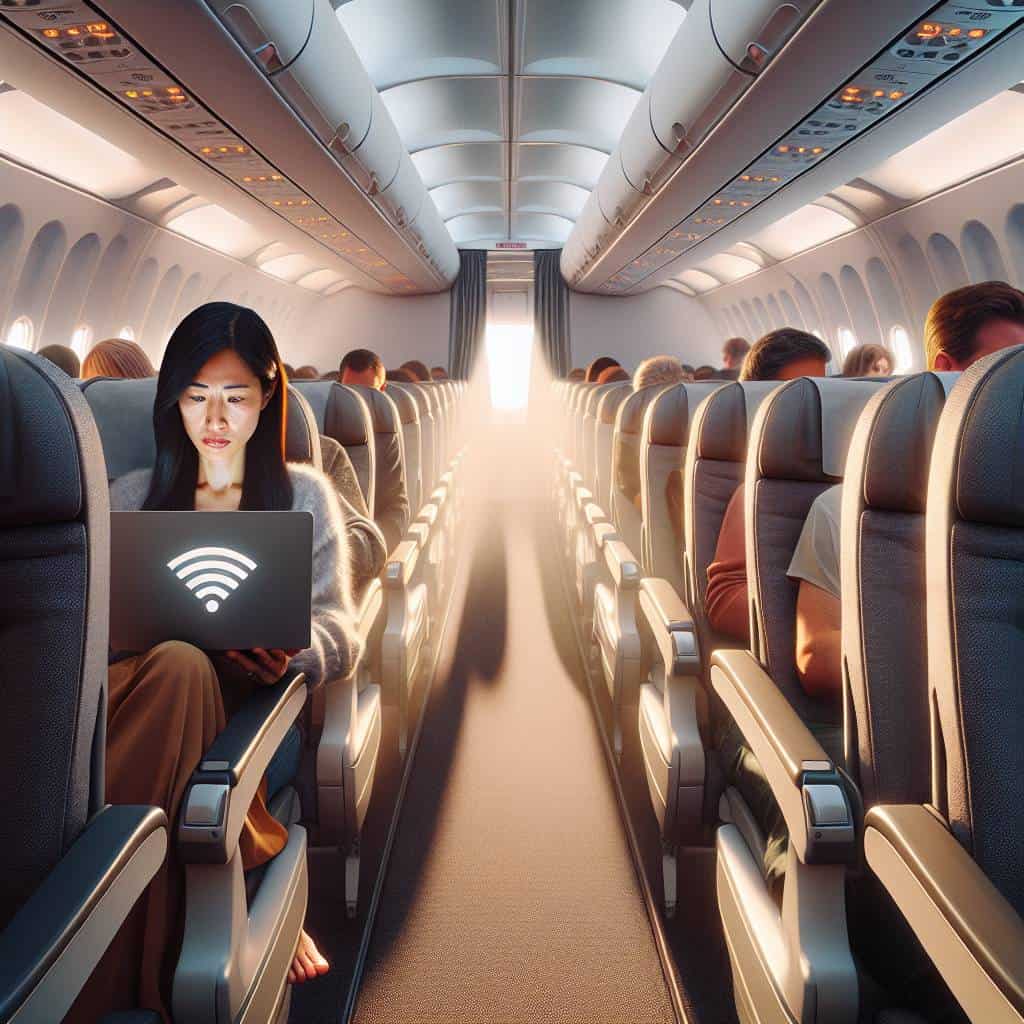
But let’s not dwell on my airborne woes. Instead, let’s dissect this digital enigma together. What can you really expect from that overpriced connection in the sky? We’ll dive into the nuts and bolts of inflight WiFi, from the tortoise-like speeds to the intricate dance of usage limitations. Trust me, by the end of this, you’ll understand why inflight WiFi is the necessary evil we can’t escape—and maybe even laugh at the absurdity of it all.
Table of Contents
When Your Connection to the Clouds Is More Like a String and a Can
Imagine you’re hurtling through the skies at 35,000 feet, an infinite expanse of blue and white outside your window, and you decide to connect to the inflight WiFi. The promise of staying plugged in while soaring above the earth sounds futuristic, right? But then reality hits you like a turbulence warning. The speed? A crawl. The connection? Flaky at best. It’s as if your link to the digital world is nothing more than a tin can tied to a string, stretching far beyond its limits. You see, inflight WiFi often relies on satellites or ground towers, both of which struggle to keep up with our data-hungry demands. The sky might be the limit, but your browsing speed certainly isn’t.
Let’s talk brass tacks, though—bandwidth. That magical word that dictates how fast you can send and receive data. Up there, it’s a scarce commodity. The connection, shared among hundreds of passengers, becomes a digital bottleneck. It’s the equivalent of trying to funnel a river through a straw. You want to stream, upload, download, and maybe even video call. But unless you’re content with endless buffering and pixelated images, you’d better curb your expectations. The technology is improving, yes, but it’s still a far cry from the fiber optic speeds we’re spoiled with on land. So, next time you’re tempted to binge a series mid-flight, remember: that string and can are working hard, but they can only do so much.
Bandwidth Battles at 30,000 Feet
Inflight WiFi is less about speed and more about the paradox of connection: tethered to the world while isolated in the skies.
Riding the Digital Turbulence
In the end, inflight WiFi is a strange beast—a testament to human ingenuity, yet a reminder of our digital impatience. It’s a signal that stretches across the sky, reminding us that even at 35,000 feet, we’re tethered to the ground. My experiences have been a mixed bag of buffering icons and fleeting connections, but they’ve taught me something crucial: patience. And maybe that’s the point. In an age where speed is king, there’s a certain humbling truth in waiting for that email to send or that webpage to load.
So, next time I find myself wrestling with the whims of inflight connectivity, I’ll try to embrace the moment. Maybe even close the laptop for a bit. Because, let’s be real—sometimes the best connections are the ones we make off-screen. As frustrating as the digital turbulence can be, it’s a reminder that not everything needs to move at the speed of light. Sometimes, the journey itself is the destination.
