I once found myself in an airport, staring blankly at a sign that seemed to mock my very existence. It was a jumbled mess of arrows and icons, a sort of visual prank designed by someone with a twisted sense of humor. Imagine a maze where every turn leads to a dead end, except this time, the stakes are missing your flight and spending the night curled up on a hard plastic bench. I had to laugh at the absurdity—I mean, who knew that a simple trip to Gate C17 could turn into an existential crisis? But there I was, a supposedly intelligent engineer, reduced to squinting at a pixelated airplane icon like it was a Rosetta Stone. Spoiler: it wasn’t.
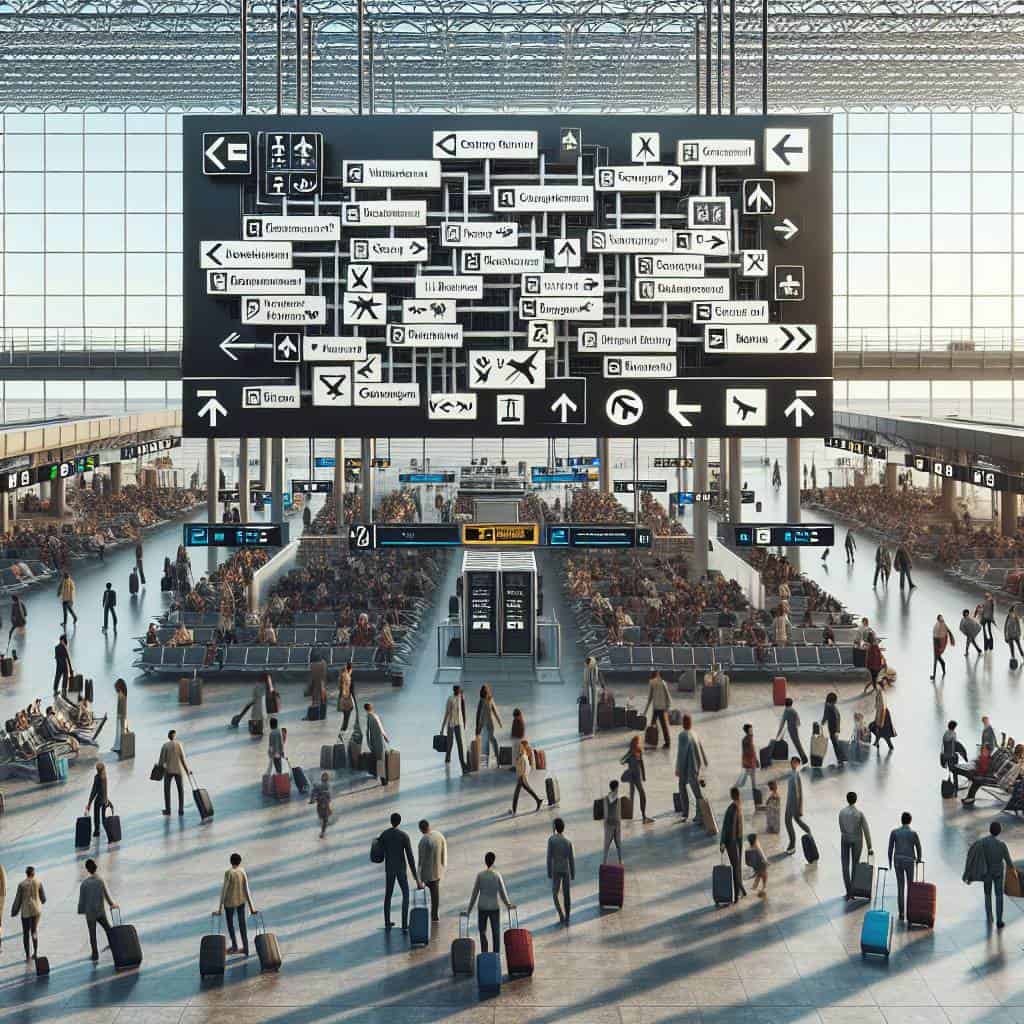
So let’s cut through the madness, shall we? Because if there’s one thing I can’t stand, it’s the feeling of being outsmarted by a piece of laminated cardboard. This isn’t just about getting from point A to point B without losing your sanity—it’s about understanding the labyrinthine logic (or lack thereof) behind those cryptic symbols and confusing directions. I’ll guide you through the chaos, deciphering the signs and sharing the gritty truth about airport navigation. Together, we’ll tackle the unspoken rules and hidden meanings, ensuring that the next time you face that fluorescent jungle, you’ll do so armed with clarity and, dare I say, a touch of cynicism.
Table of Contents
Lost in Translation: The Art of Deciphering Airport Info
Walking through an airport should be simple. But then you find yourself in this odd purgatory of symbols and signs, each one seemingly designed to baffle more than inform. It’s almost as if airports have conspired to prove that humanity, despite its technological achievements, can still be utterly confounded by a picture of a suitcase or a stylized airplane. These symbols are supposed to act as your guide, but they often feel like abstract art—open to interpretation and entirely dependent on the viewer’s perspective or mood. You might wonder if the person who designs these signs has ever set foot in an airport or if they’re just testing our collective patience.
The reality is that airport signage is an art form—a chaotic symphony of navigation and information meant to direct the masses through the intercontinental mazes. Yet, here we are, lost in translation, trying to make sense of it all. It’s not just about the symbols themselves, but the context in which they’re placed. A well-meaning arrow pointing left could lead you to your gate—or to the janitor’s closet. The trick is to learn the language of these signs, to read between the lines (or the arrows) and understand the unspoken rules. It’s a puzzle, a challenge that requires logic and occasionally a leap of faith. Embrace it, and you might just find the clarity you seek in this cacophony of visual cues.
Decoding the Labyrinth
Airport signage is less about direction and more about survival—it’s the modern-day Rosetta Stone for those who dare navigate the chaos of human transit.
Signs of the Times: A Final Reflection
In the end, navigating the tangled web of airport signage is less about the signs themselves and more about the human condition. We crave order in chaos, a beacon in the storm of humanity’s collective madness. Each symbol is a whisper from some designer’s mind, trying to lead us through the maze with the promise of understanding. But let’s face it, sometimes those whispers are more like riddles, and we’re left to decipher them with the same fervor as ancient scholars faced with a Rosetta Stone.
Yet, this struggle is not without merit. It teaches us patience and the beauty of finding clarity amidst confusion. Airports are microcosms of the world—places where cultures, languages, and people converge, each with their own stories and symbols. Understanding these signs? It’s a small victory, a reminder that even in the most bewildering of environments, our minds are capable of piecing together fragments to form a coherent path forward. And maybe, just maybe, that’s a metaphor for life itself. We navigate, we interpret, we persevere.
